
A stolen sculpture of a head in stone, dating back approximately 3,500 years, was formally handed over today by Minister Gouke Moes (Ministry of Education, Culture and Science) to the Egyptian Ambassador to the Netherlands. Prime Minister Schoof had already announced on 2 November 2025, during an official visit to Egypt, that the Netherlands would return the object in the near future. The return of the object follows an extensive investigation, which established that the sculpture had been looted from an archaeological site in the Egyptian region of Luxor and had been unlawfully exported.
The investigation and subsequent return highlight the importance of close cooperation between states, museums, art fairs, dealers, collectors and experts in protecting cultural heritage and in acting swiftly when doubts arise concerning provenance. The object was returned during a formal transfer ceremony held at the Egyptian Embassy in The Hague. In his speech Minister Moes said: “That this object was removed through looting is deeply regrettable. This stone head does not belong here, and certainly not on the art market. It belongs in Egypt.”
The stolen head
Origin
The sculpture depicts a high-ranking official from the reign of Pharaoh Thutmose III (1479–1425 BC). The head, carved from granodiorite, originally formed part of a block statue of which it was broken off. This type of sculpture was placed in graves and temples and served as an eternal representation of non-royal individuals, such as priests, senior military officers and civil officials.
Initiation of the investigation
In 2022, the head was exhibited at TEFAF Maastricht by the dealer Sycomore Ancient Art. During the fair, doubts arose regarding the object’s provenance, prompting consultation with an expert from the British Museum in London. On the basis of this consultation, the dealer proactively contacted the police, who subsequently initiated an investigation. The dealer provided all available documentation and cooperated fully with the investigation. TEFAF Maastricht also offered its full cooperation during the investigation.
Forged provenance
The provenance documentation accompanying the object suggested that the head had been circulating on the European art market for several decades. However, investigations conducted by the Dutch National Police and the Limburg Police Unit revealed that essential provenance documents had been forged by previous sellers. Simultaneously, the Historical Heritage Brigade of the Spanish National Police investigated one of those sellers. Sycomore Ancient Art voluntarily relinquished possession of the head once it became clear that they acquired the object on the basis of falsified provenance documentation. Throughout the investigation, close cooperation took place with the Dutch Information and Heritage Inspectorate, and experts from the British Museum and the National Museum of Antiquities in Leiden.
This collaboration enabled confirmation of the object’s authenticity and established that it had been looted from the Egyptian region of Luxor and unlawfully exported during or shortly after the Arab Spring.
Request for return
The Egyptian authorities confirmed that the object is protected under Egyptian heritage legislation, forms part of Egypt’s national cultural heritage and was exported in violation of Egyptian laws governing cultural property. Egypt submitted a formal request for the return of the object pursuant to the 1970 UNESCO Convention on the Means of Prohibiting and Preventing the Illicit Import, Export and Transfer of Ownership of Cultural Property. Both the Netherlands and Egypt are States Parties to this Convention and are jointly committed to combating the illicit trafficking of cultural property.
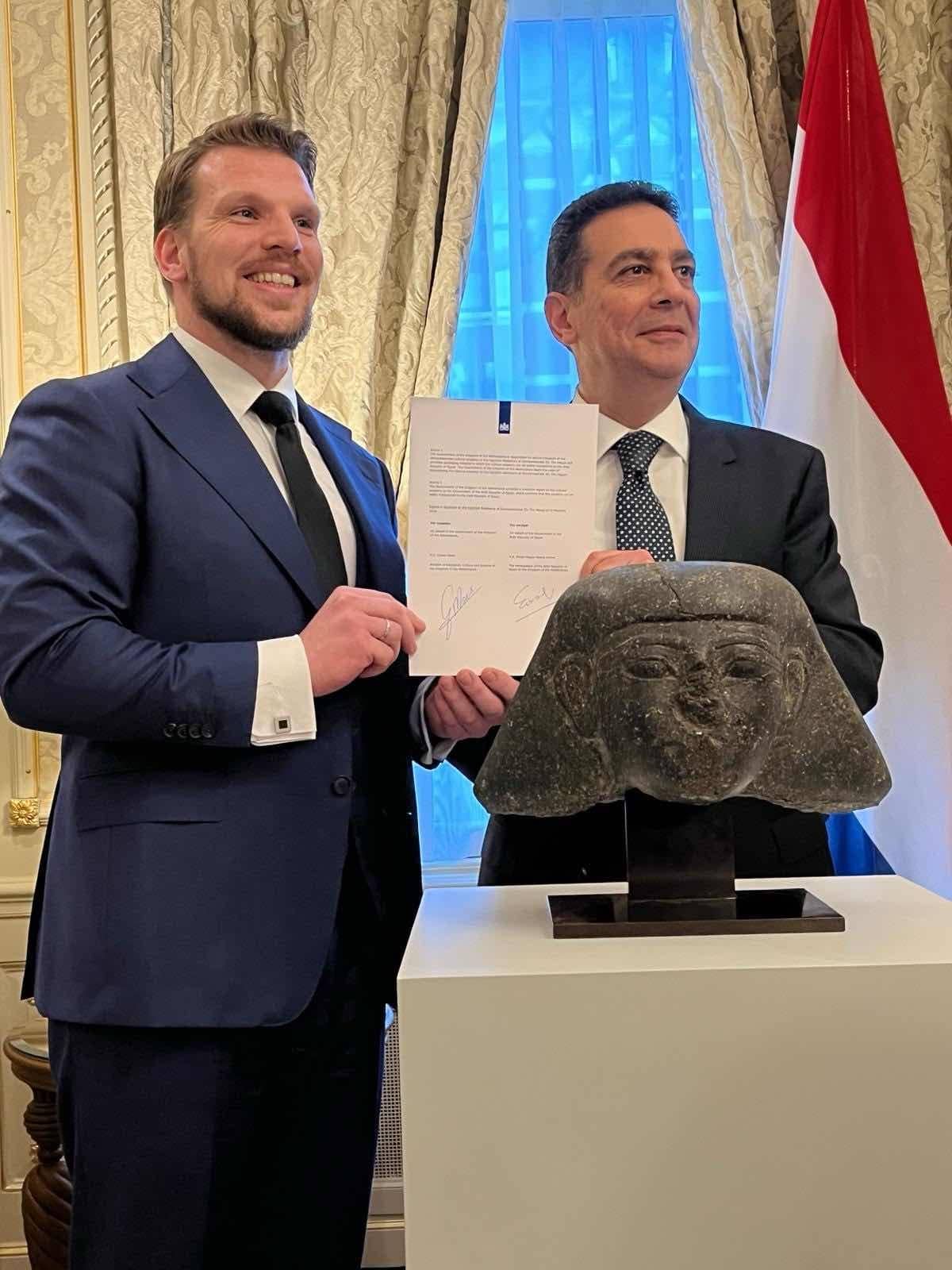
The minister of OCW and the Ambassador of Egypt at the ceremony